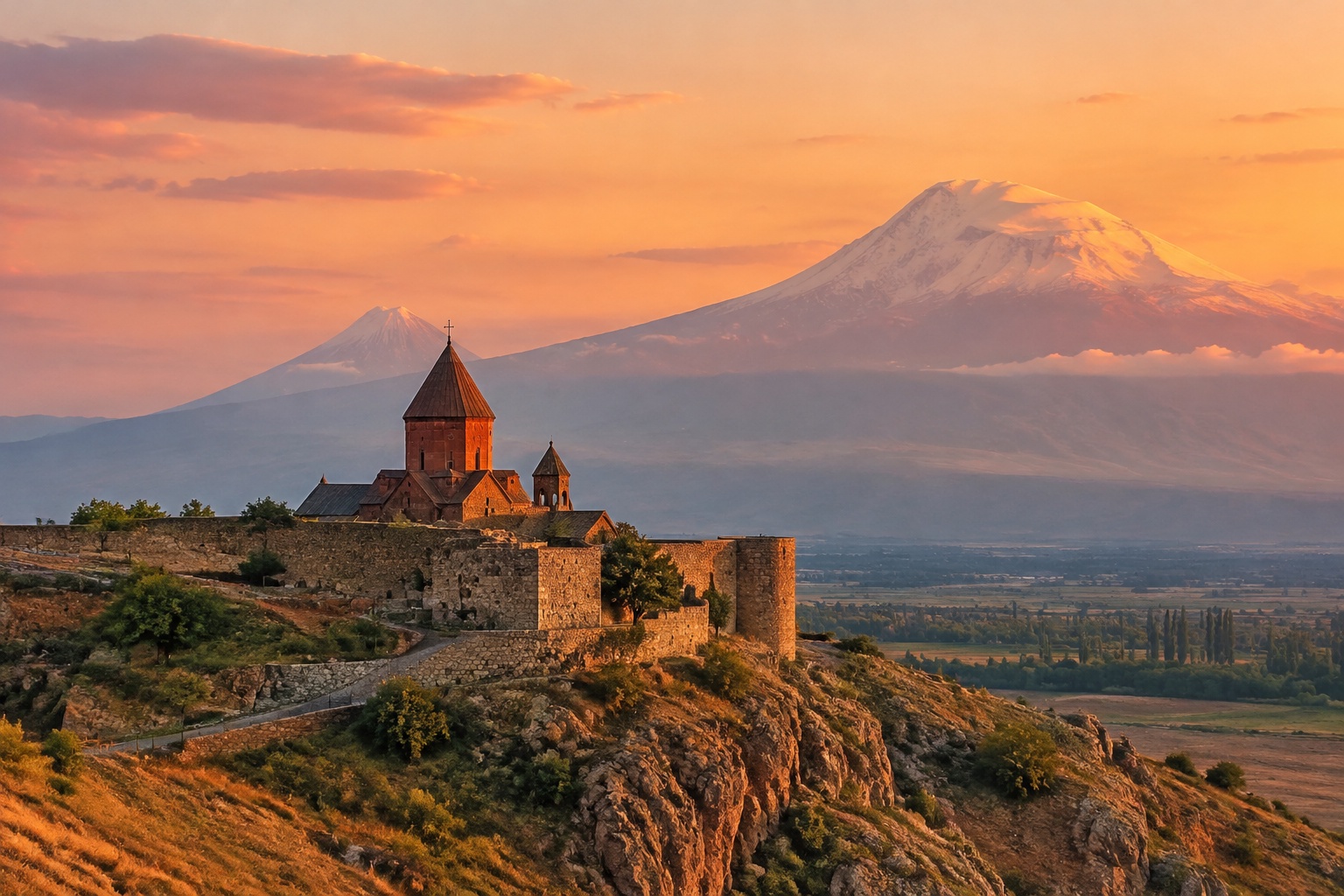
Multi-Country Caucasus
Georgia + Armenia – 8 Days
An eight-day route combining Georgian mountains and wine country with Armenia’s monastic and classical heritage.
Important route notes
- Cross-border travel requires passport, entry-policy and border-operation checks. Driving time and sightseeing feasibility must be validated before arrangements are confirmed.
The route
Day-by-day itinerary
This source-based sequence is a planning framework. Visit order, local access, available services and travel feasibility must be checked; alternatives and optional stops are not fixed inclusions.
Day 1Arrival in Tbilisi
Arrival arrangements are coordinated with your flight; no sightseeing is specified for this day.
Day 2Tbilisi → Mtskheta → Ananuri → Kazbegi
Kazbegi is the destination; no additional mountain attraction is specified for this day.
Mtskheta
Mtskheta, Georgia’s former capital, sits near the confluence of the Aragvi and Mtkvari rivers. Its historic setting and religious heritage reveal an earlier chapter of Georgian statehood; the precise visit follows the monuments named in each day’s route.
Ananuri Fortress
Ananuri’s fortified ensemble overlooks the Zhinvali Reservoir along the Georgian Military Road. Its walls and churches reflect the region’s turbulent history, while the reservoir provides a striking mountain backdrop.
Day 3Kazbegi → Friendship Monument → Gori → Tbilisi
Uplistsikhe Cave Town OR Stalin Museum: the source offers alternatives, not both as fixed visits.
Friendship Monument
The Russia–Georgia Friendship Monument stands on the Georgian Military Road above a dramatic mountain valley. Its panoramic setting makes visibility and safe roadside access especially important.
Stalin Museum
The Stalin Museum in Gori presents material connected with the Soviet leader’s life. It is a historically sensitive visit best approached critically; it is an alternative to Uplistsikhe only on days where the source explicitly offers that choice.
Uplistsikhe Cave Town
Uplistsikhe preserves a rock-cut settlement above the Mtkvari valley near Gori. Its passages and chambers reveal an ancient urban landscape, with uneven surfaces and exposed walking areas to consider.
Day 4Kakheti wine route
Kakheti winery
Kakheti is the heartland of Georgian wine culture, including the tradition of fermenting wine in clay qvevri. A winery visit introduces that regional heritage; the host, visit format and any tasting are arranged individually rather than assumed to be included.
Bodbe Monastery
Bodbe is associated with Saint Nino, whose legacy is central to Georgia’s Christian tradition. The monastery’s landscaped setting overlooks Kakheti; respectful dress and observance of worship are important during a visit.
Sighnaghi
Sighnaghi is a walled hilltown in Kakheti with streets and viewpoints overlooking the Alazani Valley. Its compact historic character provides a quieter counterpoint to the mountain routes, with distant Caucasus views dependent on visibility.
Day 5Didgori → Chronicle of Georgia → Tbilisi
Didgori is conditional on weather and roads; Tbilisi city exploration remains modest as the source gives no further named stops.
Didgori Battle Memorial
The Didgori memorial commemorates the Georgian victory of 1121 with monumental forms set across an open hillside. The exposed landscape is part of its appeal, but road conditions, weather and the day’s driving schedule determine whether a visit is practical.
Chronicle of Georgia
The Chronicle of Georgia rises above the Tbilisi Sea with sculpted pillars depicting episodes from Georgian history and religious tradition. Its monumental scale and elevated position make it a distinctive contrast to the lanes of the old town.
Day 6Tbilisi → Haghpat → Lake Sevan → Yerevan
Cross-border travel requires passport, entry-policy and border-operation checks. Driving time and sightseeing feasibility must be validated before arrangements are confirmed.
Haghpat Monastery
Haghpat’s medieval monastic ensemble stands in northern Armenia above the Debed region. Its churches and stonework are part of a UNESCO-listed heritage landscape.
Lake Sevan
Lake Sevan is a vast freshwater lake in Armenia’s highlands, where changing light and open horizons shape the landscape. A visit is a scenic stop, not a promise of swimming, boating or a monastery visit unless that stop is explicitly named.
Republic Square
Republic Square is Yerevan’s principal civic ensemble, framed by monumental buildings in Armenian stone. The broad central space offers an introduction to the capital’s architecture; fountain displays depend on seasonal operation and timing.
Cascade
Yerevan’s Cascade is a monumental stepped complex that connects the centre with higher ground. Views and the extent of walking depend on visibility, time and each traveller’s mobility.
Day 7Yerevan → Garni → Etchmiadzin → Tbilisi
Cross-border travel requires passport, entry-policy and border-operation checks. Driving time and sightseeing feasibility must be validated before arrangements are confirmed.
Garni Temple
Garni’s colonnaded temple stands above the Azat gorge, preserving a distinctive classical architectural presence in Armenia. Its setting brings together stonework and highland scenery; the visit does not imply additional activities in the gorge unless separately listed.
Symphony of Stones
The Symphony of Stones is a formation of basalt columns in the Garni gorge. Its striking geometry reflects volcanic processes, with access depending on road and walking conditions.
Etchmiadzin Cathedral
Etchmiadzin is a major centre of the Armenian Apostolic Church, with a cathedral deeply connected to the country’s Christian history. Access to particular interiors may vary with religious services, restoration and local visitor arrangements.
Day 8Departure from Tbilisi
Departure arrangements depend on your flight schedule; no sightseeing is specified.
Enquire About This Journey
Before you travel
Practical travel notes
Entry rules & border routing
Check the official entry rules for each traveller’s nationality and passport before confirming dates. Multi-country journeys depend on legal entry, border opening, transit times and local operations. The three-country source routes rely on an Azerbaijani land crossing: tourist access must not be assumed, and the route requires validation before any arrangements can be confirmed.
Mountain roads & seasonal access
Kazbegi, Gudauri and Khinalig are sensitive to weather and mountain-road conditions. Gergeti Trinity Church access and any 4x4 arrangements require local checks. Didgori is conditional on roads, weather and available time; a named stop may need to be omitted when conditions are unsuitable.
A realistic travel pace
A map does not show border queues, mountain driving, walking time or site opening hours. The two-day Tbilisi–Yerevan–Sevan route, the Gobustan–Absheron combination and long multi-country stages need careful timing. Tell us about mobility needs and preferred pace before the route is agreed.